

How Do Trees Get On The Internet
Underground Establish Ecosystem: How Are Plants And Trees Continued To Each Other?
Updated on: 8 Jul 2022 by Ishan Daftardar
The undercover plant ecosystem is a circuitous network that connects plants to each other via their roots. This network is made upwardly of fungi, which act like secret Internet fibers, linking the roots of different plants. The purpose of this network is to share nutrients and information amidst the plants.
Allow me tell y'all something, you should never underestimate the power of nature. Information technology has always improve than u.s. at everything it does, and this isn't likely to change someday soon. In fact, nature is e'er one step ahead of u.s., and nosotros depend on it heavily for our survival. At this point,we can safely assume that, 'no copse' would basically mean 'no humans'.

That's the power of nature.
Human arrogance has e'er led the states to assume that we are the highest on the ladder when information technology comes to evolutionary superiority. However, mod science has discovered something that should accept u.s. down a peg or two: There is an underground Internet connexion among trees…..Well, not Internet, per se, only something pretty darn shut!
More specifically, scientists in the UK have constitute an extensive undercover network connecting plants via their roots.
Recommended Video for yous:
How is this Possible?
Oh…the irony
The underground plant ecosystem is more circuitous than you think. Information technology acts as a kind of huge information information center that handles tons of data and transfers it from i plant to another. All the same, the roots don't play a major office in this information substitution. The main components are the vast array of fungi that are nowadays underground. While mushrooms might be the nearly famous blazon of fungus, well-nigh of their bodies are made up of a mass of thin threads, known as mycelium. Research has shown that these threads deed like underground Net fibers, linking the roots of unlike plants.
The family of fungus that links trees is called mycorrhizae.
That sounds cool, but what'southward the purpose of this so-called Tree Internet?
This is where things become interesting. These fungi aren't just sitting at that place idly; they share nutrients and information with the surrounding plants, effectively forming a sort of a mutual relation among the plant customs.
Forest ecologist Suzanne Simard and her colleagues from the Academy of British Columbia have made an interesting discovery. Large trees help the small ones flourish past supplying nutrients to them. She showed that Douglas fir and newspaper birch trees can transfer carbon between them via this versatile mycelia.
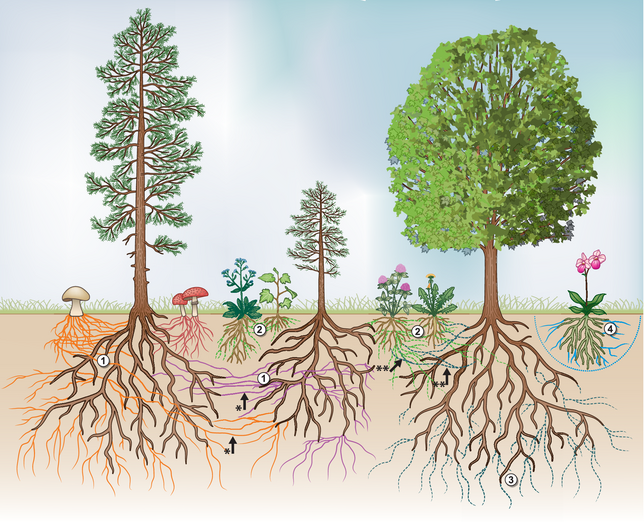
Older copse provide nourishment to younger saplings.
The range of plants provide fungi with food in the form of carbohydrates. In commutation, the fungi help the plants suck upwards water and provide nutrients like phosphorus and nitrogen via their mycelia. This is basically a symbiotic procedure.
Another interesting thing to note is that this fungal network boosts the host plants' immune system, because when a fungus attaches to the roots of the plant, it releases defence force-inducing chemicals. This makes the institute more than resistant to diseases.
Other Forms of Advice Among Copse
Evil tree
Just like the plant Internet, there also exists a sort of a mobile phone service in the plant kingdom.
The plants release defensive chemicals above the ground that kills pests and likewise warns the surrounding plants of the incoming attack. Above-footing chemicals can too attract predators that eat pests.
Surprise! Surprise! Copse oftentimes commit crimes against other trees!
They organize attacks on unwelcome plants by spreading toxic chemicals through the fungal network. This is the tree form of cybercrime. Just as there exists a night side of the Net, these sorts of hidden crimes are also committed amidst plants.
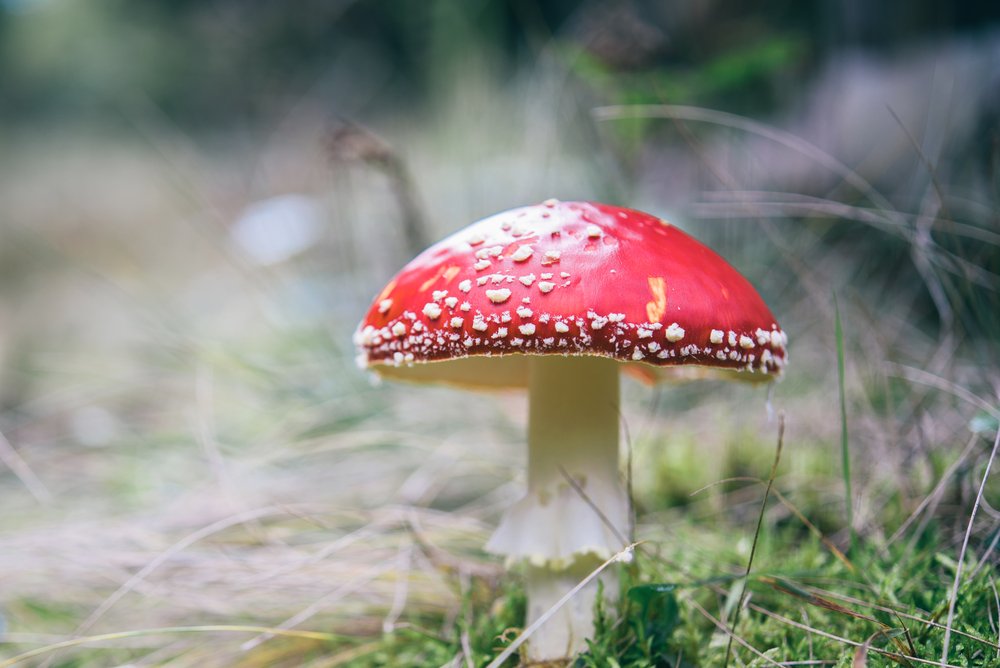
Toxins are transmitted via the fungus. (credits: AdrianC/Shutterstock)
There are many plant goons that harm other species of plants. For example, some plants steal from each other using the fungal network. There are as well plants that don't have chlorophyll, so unlike near plants, they cannot produce their ain free energy through photosynthesis. Plants similar the phantom orchid go the carbon that they require from neighboring trees by stealing from their fungal network.
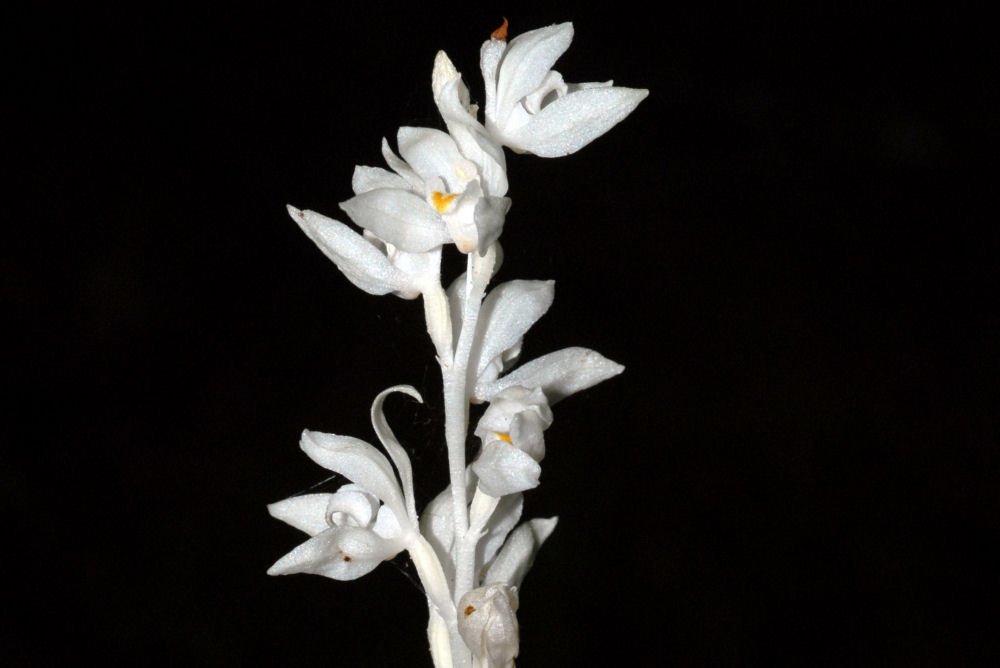
They might expect pretty, but they're the goons of the plant kingdom.
From all this information, we can conclude that plants aren't actually that dissimilar from animals. They also commit petty crimes confronting each other. I guess that'south the manner Mother Earth created united states, in club to maintain equilibrium!
Sources
BBC Earth
Suggested Reading
-
Entangled Life: How Fungi Make Our Worlds, Change Our Minds & Shape Our Futures -
The Revolutionary Genius of Plants: A New Understanding of Plant Intelligence and Behavior -
Mycelium Running: How Mushrooms Tin Help Salve the Globe


Was this commodity helpful?
Yeah No
Assist united states of america brand this article better
Follow ScienceABC on Social Media:
About the Author
Ishan is a Mechanical Engineer from Mumbai University, Bharat and is obsessed with scientific discipline, nutrient and all things football. He is a self proclaimed cyclist, runner and a professional procrastinator.
.
Science ABC YouTube Videos
-
 Quantum Physics: Here's Why Movies Always Get It Incorrect
-
 Do Fish Get Thirsty and Do They Demand to Drink Water?
-
 Gasoline (Petrol) vs Diesel: Which i is better? A Beginner'south Guide
-
 Blackness Holes Explained: What Is a Black Pigsty? How They Form?
-
 Gut Microbiome Explained in Simple Words
-
 Particle accelerators: What are they, how do they piece of work and why are they important to us?
-
 How Do Neurons Work?
-
 How Scientifically Accurate Is The HBO Miniseries Chernobyl?

How Do Trees Get On The Internet,
Source: https://www.scienceabc.com/nature/talking-trees-internet-real-underground-network.html
Posted by: andersenhurs1992.blogspot.com
0 Response to "How Do Trees Get On The Internet"
Post a Comment